
Are we missing Something Big in our search for a Cure for Cancer? (Part 1)
A prelude to a review of the book "Tripping over the Truth" by Travis Christofferson

It wasn’t so long ago when I thought it was impossible to build a machine that generated more energy than it consumed. So-called greater-than-unity devices would violate the first law of thermodynamics. And laws cannot be broken.
Sure, that law is 175 years old. But even if Lord Kelvin was wrong and such technology existed we would surely know about it. Imagine how much better life would be! We could power our homes and businesses, light the streets at night and grow food much more inexpensively. Pollution would decrease, the environment would be restored and we would have more resources to address poverty, lack of education, poor access to clean water. Why would anyone keep such technology secret?
I was naive then. That was before I opened my eyes to the events of 9/11.
That’s the South Tower blowing up in front of your eyes. In case you missed it in slow motion, the massive corner column of the building remains intact for sometime while fiery explosions occur next to it and far below the crush zone. It’s not falling down. It’s not “crushing” itself. This building is being destroyed from the top down from massive explosive events throughout the structure. That’s not just what your eyes are telling you. That’s what 118 firefighters and three dozen news sources said as it was happening.
The media will not only avert their eyes to certain things, they will castigate those who point them out. And they encourage their listeners to follow their lead. They serve as the lens through which the public apprehends and interprets the world. They tell us who to believe, who to mock, what exists and what doesn’t. We don’t have to listen to them. We always have the freedom to slow down and look more closely. That’s what the clip above demonstrates.
Back to free-energy devices…
There are secrets around energy production that are kept from the public. The public accepts this as the price for safety, or as the government would call it, National Security.
The last time the we got a peek at the kinds of ideas which are being hidden from the public was in 2010 through a FOIA request by the Federation of American Scientists. To my knowledge this is the only Patent Security Category Review List that has ever been declassified. This document lists the kinds of new technologies that our government deemed inappropriate for the public back in 1971. We can understand the need to prevent new ideas about explosives and missile guidance systems from getting out to the public, but what is the intent in keeping things like these secret:
high energy per volume batteries (Group XI, item 1)
unusual and efficient energy conversion devices (Group XI, item 3a)
solar photovoltaic generators with greater than 20% efficiency (Group XI, item 8)
energy conversion systems with efficiencies greater than 70% (Group XI, item 9)
vehicular drag reduction systems (Group XIX, item 12)
any invention directed to fuel economy and efficiency (Group XXIII, item 8)
If our government felt that the public shouldn’t know about technologies that offer greater efficiency with regard to energy production and conversion 54 years ago in the middle of an oil crisis, how would they feel about a machine that created energy out of thin air? If such technology existed would the public ever find out about it?
I don’t believe so. After all, the government is not only restricting certain technologies from reaching the public, they are going so far as to restrict the public from knowing which technologies they are hiding. This is the only patent security list ever released to the public, and it is a half century old.
But the engineer in me remained skeptical. That’s part of the education we receive in college. Good students are skeptical of anything that upends what our teachers know to be true. If free energy devices could be built, the establishment experts would have done it first.
It wasn’t much later when I became acquainted with two people, both of whom I now consider trusted friends, who informed me that they had not only seen free-energy devices with their own eyes, they had been present when they were being vetted by establishment engineers who sought to prove that the inventors were making fraudulent claims.
In both cases the engineers proved to themselves that the devices were doing the seemingly impossible. In both cases, the inventors admitted that they really didn’t understand how their inventions worked. And in both cases the inventors were soon approached by important appearing folks who “advised” them to not pursue what they stumbled upon.
Men in suits appearing out of unmarked vehicles soon after their devices were validated by government experts? Yes, it sounds like a movie script to lure and radicalize the conspiracy-minded. However if such technology existed it must be hidden, otherwise we would be living in a much different world right now.
Is it an internally consistent paranoid delusion or something to consider seriously? It all comes down to one’s world view. My world view allows room for the possibility that huge secrets can be kept from the public indefinitely. A cadre of secret agents weren’t deployed to hide the demolition events of 9/11. We were simply told to look the other way and ostracize anyone who asked questions.
Astrophysicist, friend and collaborator, Josh Mitteldorf, PhD, penned a series of essays on some of the stories of greater-than-unity devices, citing some of the more compelling evidence and the peculiarly irrational response they generate from the folks in charge. I invite you to start here if you are so interested:

“Secrecy around the availability of abundant energy is maniacal”, one of these friends explained, “it’s not about the trillion dollar petroleum industry it would destroy. It’s about its potential to liberate humanity they are so worried about. They attack free energy technology almost as ruthlessly as they do with cures for cancer.”
Cures for cancer are being suppressed too?! Now the doctor in me was skeptical.
As luck would have it, I have since met others who know people who, in their opinion, have indeed found cures for cancer. They claim that they have seen the results with their own eyes. Cancer cured. Chemotherapy and radiation aren’t required. There are no side effects, and they have a near 100% success rate.
I remained incredulous. I argued that there are plenty of people who peddle cancer “cures”, looking to make a pile of cash from hapless cancer patients who either distrust doctors or have been told there’s nothing more that the system can offer them.
“Nope”, explained someone who saw their friend cured after a decade long battle with multiple myeloma which left her wheelchair bound from painful bone lesions throughout her body, “those who possess real cures never, ever advertise. They have learned that if they wish to continue to cure people they must do it in absolute secrecy.”
Obviously, the only way to verify that such treatments are legitimate would be to put them to the test in a properly designed trial. But none of these cancer cure wielding individuals would dare to make their discoveries public, let alone publish results. So the curing continues in obscurity so that the lives of their patients (and their own) can be extended.
Were there really people out there somewhere curing cancer behind closed doors? Maybe. But it would be highly implausible because if such cures were discovered by people working independently why then haven’t our own highly funded establishment researchers found them too? Once again we are confronted with an internally consistent alternative reality which requires the suppression of transformative technology and science institutions that are discouraged from thinking outside the box.
I’m an anesthesiologist, not an oncologist. I do not understand the mechanism of these purported cures which I have been told about second hand. I can only say that these particular “cures” were completely different from each other in their approach—at least that is what I have gathered from two different sources, neither of whom have medical training (nor any reason to sensationalize their experience).
My professional interaction with cancer patients is strictly in the operating room. Not every cancer can be treated surgically. Indeed those who enter the OR for an excision of their tumor are hopeful. Their cancer has been localized to one part of their body and is therefore amenable to resection and cure without the need for dreaded chemotherapeutic agents.
An immense amount of trial data supports our approach to the multitude of different forms of cancer. Early diagnosis allows for immediate surgical resection in some forms. Other patients may have to undergo chemotherapy or radiation treatment first. Others may never be able to see their cancers localize to an extent where surgery is possible.
Cancer, as it was taught to us in medical school 30 years ago, is primarily a genetic problem. This was perhaps most elegantly demonstrated in a paper, “Mutation and cancer: statistical study of retinoblastoma”, published in the Proceedings of the National Academy of Sciences of the United States of America by Alfred G. Knudson, Jr. in 1971.
By examining the emergence of retinoblastoma in children he postulated that there was a tumor suppressing gene (later identified and named RB1) which would prevent the development of this cancer of the retina.
We each have two versions of a DNA sequence which codes for a protein—one from each of our parents. Each version is called an allele.
Knudson postulated that some children in his case series inherited a defective allele that coded for a protein that would prevent retinoblastoma and would develop the cancer if the other allele in one of their cells became damaged from exposure to something in the environment (i.e. a carcinogen). These children would typically develop the cancer in both eyes and at an earlier age compared to children who developed the cancer later and in only one eye. This second group must have been born with a perfectly good pair of alleles but were unfortunate enough to have both damaged from some type of environmental exposure. This is why the cancer emerged later and in only one eye.
This study of 48 children led to the widely known “Knudson Two-Hit Hypothesis”: cancer emerges when a cell having two damaged alleles which code for a protein that suppresses cancer begins to replicate.
Of course this was an oversimplification and could not explain all that has been observed before or since. Nevertheless the bulk of our chemotherapeutic agents target mechanisms thought to be involved in cell division and replication—something that proceeds unchecked leading to tumors.
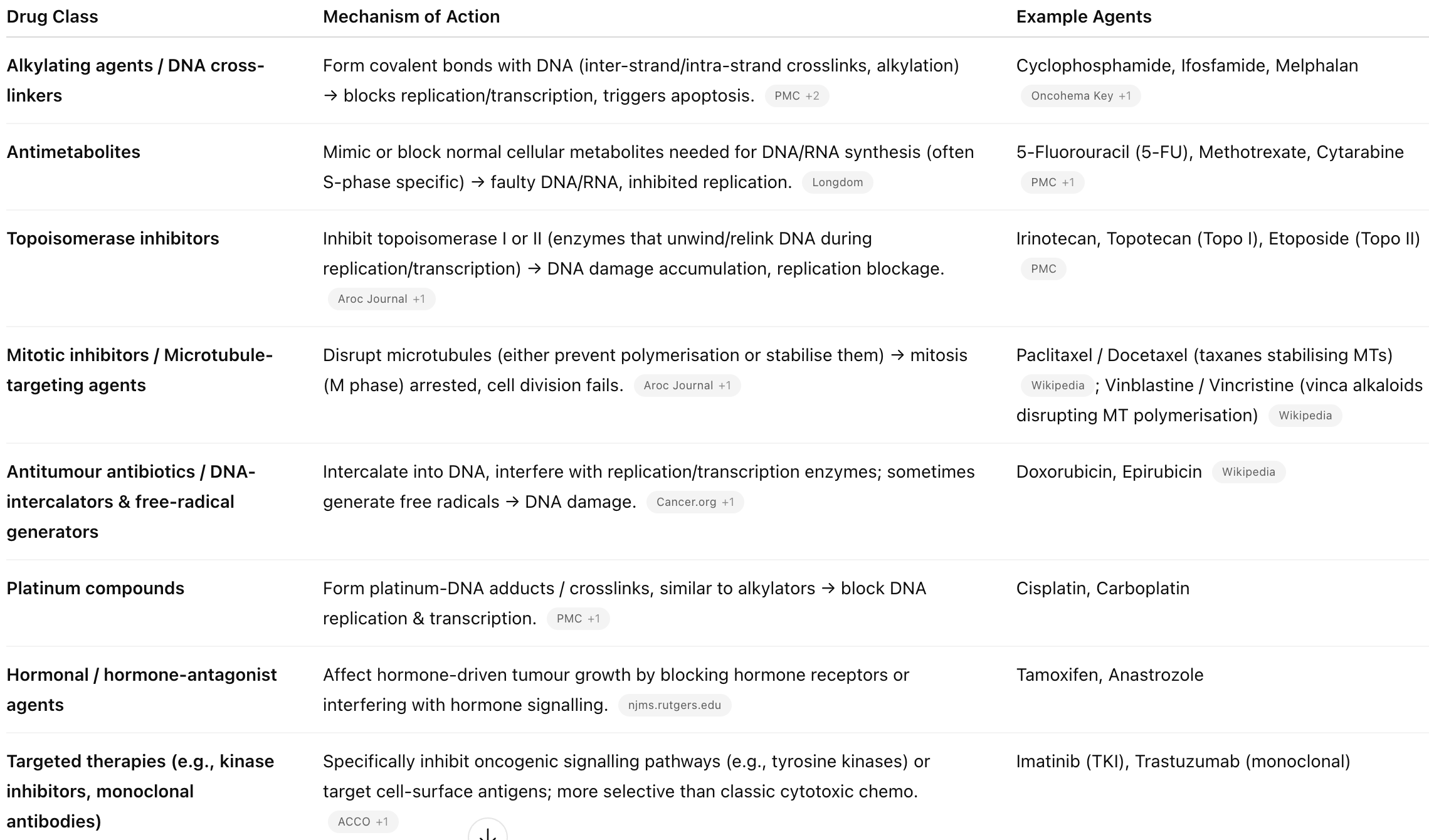
As you can see, most of these agents interfere with DNA synthesis, transcription or the process of cell replication (mitosis). Some also interfere with hormone driven tumor growth. Newer, “targeted” therapies encourage our immune system to target cancer cells.
Aside from the immunologic therapies, these drugs are not completely specific to cancer cells and can seriously disrupt the function of normal, healthy cells leading to very harsh side effects.
Cancer is thus a genetic disease. Either you inherit an abnormality or you are exposed to a carcinogen which results in a mutation of a key DNA sequence or both.
States the National Cancer Institute:
“Cancer is a genetic disease—that is, it is caused by changes to genes that control the way our cells function, especially how they grow and divide.”
How have we been doing in our fight against Cancer?
Pretty good. Sort of…
It turns out this is a difficult question to answer. Progress has been made, but at what cost?
Let’s start here:
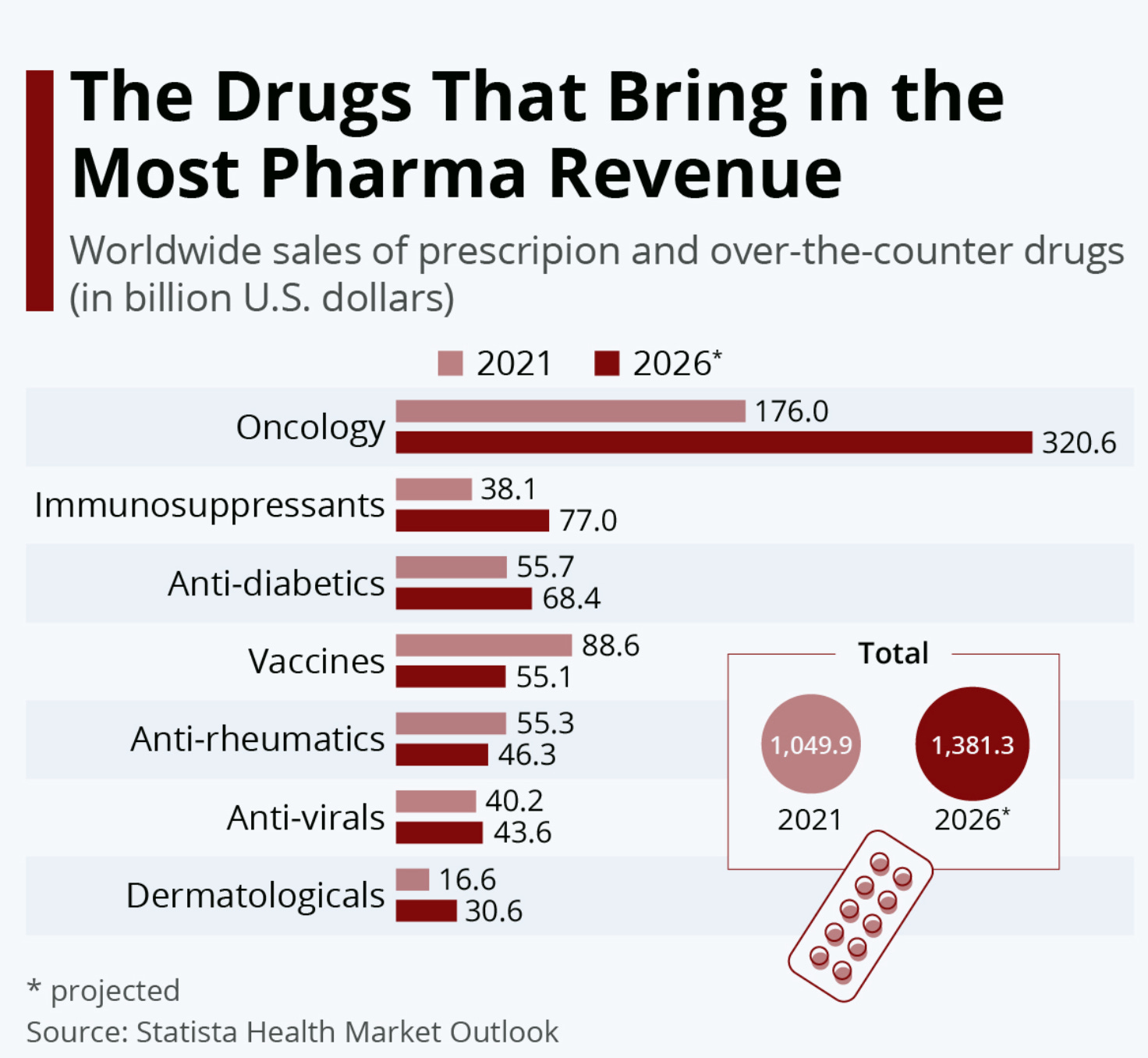
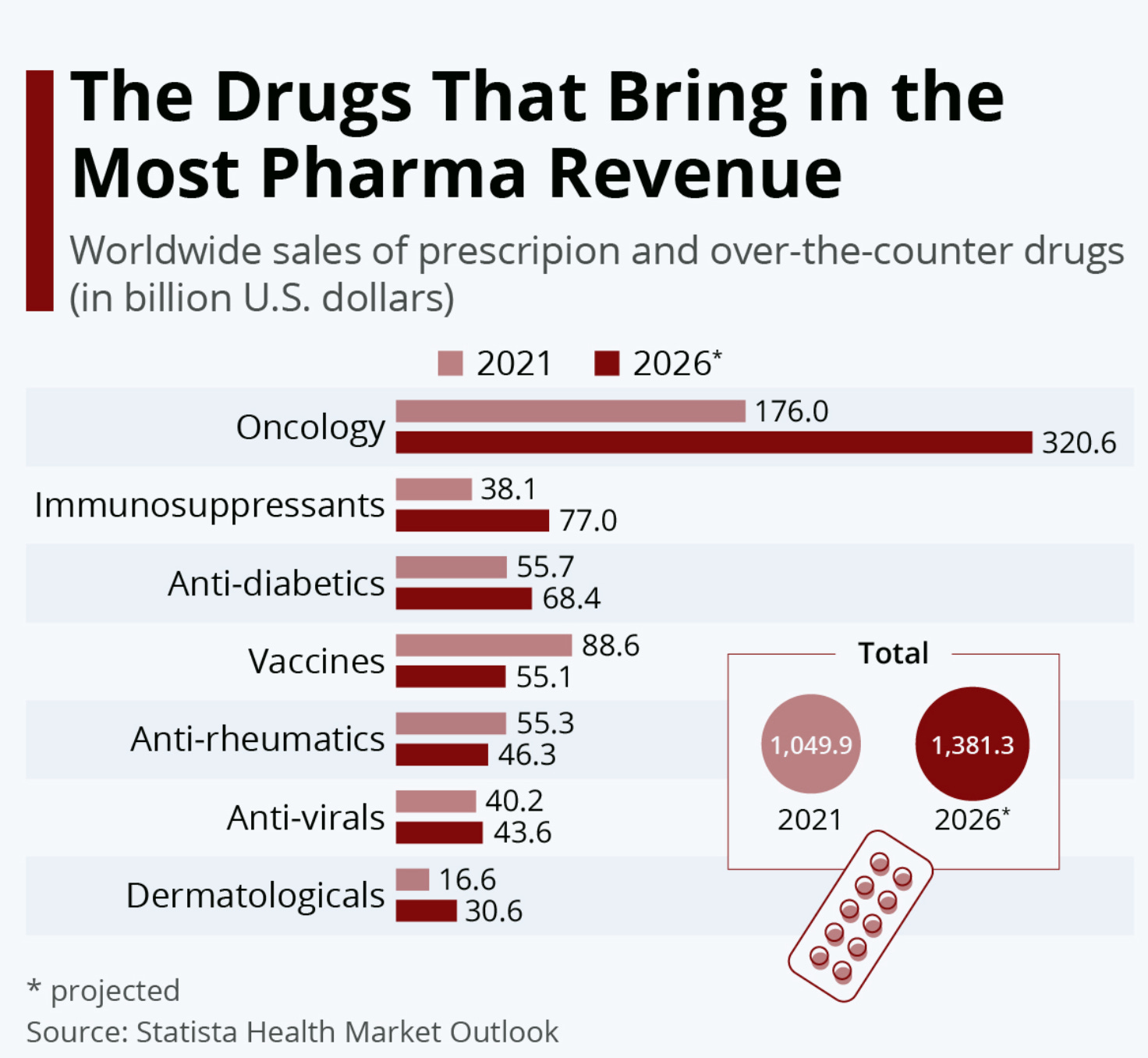
In 2021 oncologic agents brought in the most Pharma revenue, exceeding both vaccines and diabetic drugs combined. Oncology drugs made up about 15% of all drug sales in 2021 and is projected to reach 25% by 2030 when it will nearly match the next six highest categories combined.
Cancer has been the second leading cause of death in the USA for over a century, second only to Heart Disease. Are things getting better? Data demonstrates that year over year mortality rates from cancer are sliding. However this data is age-adjusted, meaning that at any given age, the chance a person will die from a Cancer diagnosis is going down over time. That’s good.
But when it comes down to the number of deaths from cancer every year, the numbers are not as encouraging. In fact, I had some difficulty finding reliable statistics about this metric, the crude rate of cancer mortality, something that is interestingly not readily available. I had to go the the CDC and use their database querying engine called “CDC Wonder” to get some crude mortality rates from Cancer. Only data since 1999 (and interestingly not beyond 2021) is available. Here’s what it showed:

The blue line represents the age-adjusted Cancer mortality from 1999-2021. The progress has been substantial, dropping from 200 deaths per 100 thousand people per year to 143—a 28.5% improvement.
The green line represents the unadjusted, or crude rates. This number represents the number of people who are dying every year from Cancer. It’s decreased from 197 deaths per 100K per year to 182—an 8% improvement.
Taken together this means that the risk of dying from cancer in a year is only slightly less than it was at the turn of the century, but the risk of dying from cancer at any given age is substantially less. People are living longer. This is reflected in the way the field of oncology generally self-assesses. Therapeutic effectiveness is primarily measured in survival rates, not cures.
Is the two hundred billion dollars a year in oncologic agents worth it? That’s an even harder to question to answer, especially given the fact that it is difficult, if not impossible, to extract the actual benefit of these interventions in lieu of the reduction in smoking since 1991 and earlier detection through more regular screening (e.g. mammography, colonoscopy and PSA levels in men).
What some Oncologists are saying
I’ve maintained contact with only a handful of my medical classmates from 30 years ago. Most of them happen to be oncologists for whom I hold a great deal of respect and affection. I asked them to assess their field, its progress and future. Their responses were similar:
They expressed cautious optimism around the advent of immunotherapy, a means of activating a patient’s immune system to attack cancer cells.
They agreed that cancer is multifactorial and that a single cure for cancer is unlikely to ever be found.
Given that cancer is a tough nut to crack, progress over the last 25 years is acceptable if not commendable.
This is the way I have regarded the field of oncology too. Given the fact that progress has been relatively modest (per crude cancer mortality rates), the question is whether or not something big is being missed, not from gross negligence or bad intentions but from honest oversight that is part of a culture that stems from a hyper focus on the idea that, as the National Cancer Institute asserts, “Cancer is a genetic disease”.
This is not an easy question to answer. The book “Tripping over the Truth, How the Metabolic Theory of Cancer is Overturning One of Medicine’s Most Entrenched Paradigms” makes an admirable attempt to do so. Author Travis Christofferson manages to transform the prosaic topic of oncology into an entertaining series of vignettes that weave primary findings of essential research, history and the personal stories of key figures into a digestible, historical non-fiction novel leaving the reader with huge real world questions to consider.
I will offer a review of the book in a subsequent post.
Please leave your comments.
I highly recommend viewing the documentaries on Dr. Stanislaw Burzynski - original one here:
https://www.youtube.com/watch?v=Ro8C75XykLo
This is a very serious documentary, and I would rank the implications of this on par with Covid-19 and 9/11
relevant links related to this topic:
https://www.burzynskimovie.com/ (links to subsequent 2021 interviews were removed form youtube, but you can find them on rumble if you search for each separately)
https://ericmerola.com/ (I haven't viewed any of his other documentaries, but the youtube film from above is linked from his compilation page under Burzynski: Cancer is Serious Business)
https://www.burzynskiclinic.com/
Heads up...your article omitted any reference to cardiovascular drugs. ChatGPT told me: "global‐market estimate: the global cardiovascular drugs market is estimated at about US $153.7 billion in 2024 and projected to reach about US $157.8 billion in 2025."